
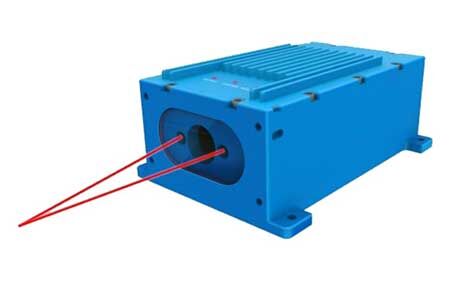
The DBM Laser Doppler Speed and Length Measurement System is a non-contact, high-precision solution designed for the steel industry. It leverages advanced optical technology and real-time signal processing to monitor high-temperature (up to 1000°C) and high-speed production environments, achieving an accuracy of ±0.05%. It is used for precise speed control, precise length control, elongation, mass flow control, shearing and slitting control, and inkjet printing control. Its core value lies in eliminating mechanical wear and enhancing production efficiency while ensuring product consistency.
Real-time speed/length monitoring of 1000°C slabs, ±0.1% accuracy.
After the high-temperature billet passes through the continuous casting machine, a laser length measuring system precisely measures its length, guiding a high-speed cutting machine to cut it precisely to the preset length, significantly reducing scrap rate and material waste.
During the hot rolling process of steel strip, laser speed and length sensors monitor the running speed and cumulative length of the strip in real time, ensuring the stability of the rolling speed and the final dimensional accuracy of the strip, providing key data for automated production lines.
For the production of various profiles such as H-beams and I-beams, precise measurement of their length during cooling and transportation optimises the cutting scheme, improving production efficiency and product quality consistency, and reducing scrap.
On seamless steel pipe or welded pipe production lines, laser sensors are used to measure the extrusion or rolling speed of the pipe in real time and cumulatively calculate its length to achieve precise length cutting and inventory management.

The Electrical Team of the Bar & Wire Rod Production Section at Shougang Changzhi Iron & Steel Co., Ltd. optimised the tail steel length control in its high-speed bar production line. This initiative effectively prevented pile-up accidents, reduced non-standard lengths, and improved the material yield rate, generating over
All-Fibre Design
Compact structure for complex layouts, resistant to dust and vibration.
1550nm infrared light source, eye-safe and suitable for harsh industrial environments.
Ultra-High Precision
50,000 samples/sec AD conversion with FPGA processing, accuracy ±0.05%, repeatability ≤0.02%.
Zero-speed detection and automatic direction recognition, covering 0-1100 km/h.
Extreme Environment Adaptability
High-temperature models (e.g., ZK-D-SL1500) withstand 1000°C steel surfaces with automatic gain control to resist scale interference.
IP66 protection, operating temperature -20°C to 50°C, ideal for hot rolling, cold rolling, and casting.
Multi-Protocol Integration
AB pulse, RS422/485, Modbus support for seamless PLC/MES integration.
Synchronised camera triggering for defect detection and quality control.
1. ZK-D-SC/H/L series. The type of Laser Doppler Velocimeter is suitable for the manufacture of various metal products, such as bars, tubes, wires, plates, strips, hot rolling, cold rolling, etc., real-time online accurate measurement of speed and length, and can measure 1000 ℃ high-temperature billets.
2. ZK-D-SL1500, dedicated to the continuous casting production line, can measure 1000 ℃ high-temperature steel billets, adapt to lower speed measurement, and adopts an automatic light intensity gain function for the surface of iron oxide scale; the measurement accuracy can reach ±0.1%.
Contact us for a quotation >>>
1. Pulse-triggered camera for visual defect recognition
While the laser Doppler velocimeter measures the speed and length of the object online, the editable pulses sent by the velocimeter are used to trigger the camera to collect images. No matter how the speed changes, it will ensure that a clear image of the surface of the object to be measured is collected in equal proportions. achieve defect identification.
2. Speed and position information, such as laser coder, is provided
The laser Doppler velocimeter can accurately give speed and position information, and the text patterns, logo marks, two-dimensional codes, etc. processed by the editable pulse-driven laser coding machine have high precision, and the processing effect is uniform.
3. Instantaneous speed measurement: ultra-fast sampling frequency, 50,000 times/second
ZK-S- Instantaneous Speed. This type of speedometer is suitable for instantaneous speed measurement. The sampling frequency is 50,000 times per second, the sampling time is as high as 0.02ms, the maximum instantaneous speed of 300m/s can be measured, and multiple pulses can be output, which can be used in a very short time. It measures the instantaneous speed of a high-speed moving object with a length of only a few centimetres.
For example, cylinder measurement, piston, Hopkinson rod, and other instantaneous speed measurements
4. Elongation rate difference measurement
Speed Range: 0-1100 km/h; unlimited length (pulse-based).
Power Supply: 20- 28V DC, 11W consumption.
Outputs: AB pulse, RS422/485, Modbus TCP.
Protection: IP66, suitable for dusty/humid steel plants.
Q1: How does a Laser Doppler Velocimeter (LDV) overcome the accuracy issues of traditional contact encoders?
A: Traditional contact measuring wheels often suffer from slippage, mechanical wear, and diameter changes due to thermal expansion, leading to measurement errors. Our LDV utilises non-contact optical technology to measure speed via the Doppler frequency shift of laser interference fringes. This ensures a constant precision of ±0.05%, regardless of material vibration, high-speed acceleration, or surface conditions.
Q2: Can the laser head survive in areas with heavy steam, dust, and high radiant heat?
A: Yes. The system is specifically engineered for the “Red Zone” of steel mills. It features an IP67-rated stainless steel enclosure and an integrated Air Purge system that creates a high-pressure air curtain to keep the lens free of dust and steam. For installations near continuous casters or reheating furnaces, we provide an optional water-cooling jacket to ensure internal electronics remain stable in ambient temperatures exceeding $100^{\circ}C$.
Q3: How does implementing an LDV system translate into direct cost savings for our mill?
A: The ROI is primarily driven by Yield Optimisation. Precise speed and length measurement allow for:
Exact Crop Shearing: Minimising head and tail scrap, which can save tons of finished steel annually.
Elongation Control: In skin-pass or cold rolling mills, accurate differential speed measurement ensures perfect tension and elongation, reducing strip breakage and quality rejections.
Maintenance Reduction: With no moving parts in contact with the steel, you eliminate the downtime and spare parts costs associated with mechanical encoder repairs.
Q4: Is the velocimeter compatible with our existing PLC/MES automation architecture?
A: Absolutely. The device supports a wide range of industrial interfaces, including RS232/485, Ethernet (TCP/IP), Profinet, and 4-20mA analogue outputs. It provides real-time pulse signals that integrate seamlessly with your PLC for high-precision flying shear control and synchronised mill stand speed adjustment.
Q5: Does the equipment require frequent recalibration to maintain its accuracy?
A: No. Unlike mechanical systems that require periodic calibration due to wheel wear, the LDV’s measurement is based on the fixed wavelength of the laser, which does not drift over time. Daily maintenance is minimal, typically involving a quick check of the air purge supply and a simple wipe of the protective window, significantly reducing the workload for your maintenance team.