

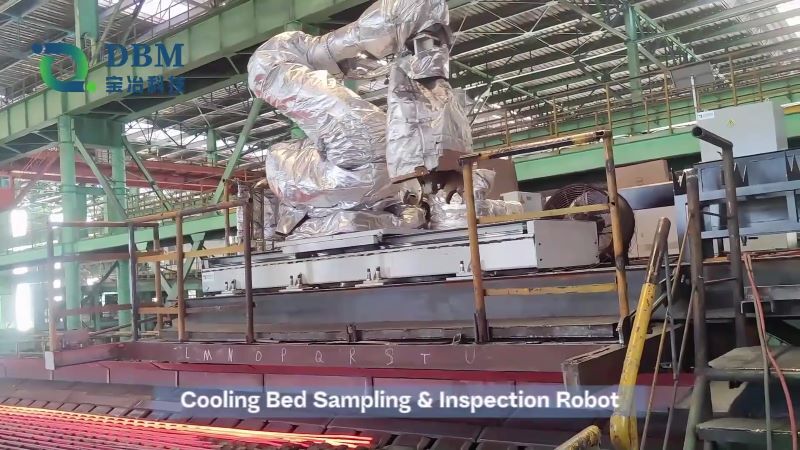
This system is a highly automated and intelligent control system designed mainly to solve the problem of manual sampling in the bar workshop. It is installed at one end of the bar line walking cooling bed. The system can completely replace manual sampling work, ensure the reliability, accuracy and timeliness of sampling, and at the same time, after the sampled samples are water-cooled, the size and surface quality are measured, replacing manual single and repetitive work to improve work efficiency.
In the sample collection area on the cooling bed, the rebar is still in a high temperature state, the steel temperature is about 800°C-1050°C, and the air temperature also exceeds 100°C. The working environment is harsh. Due to the non-smooth TMT surface with the rib and the structural characteristics of the cooling bed, the rebar has the risk of splashing and hurting people during the operation of the cooling bed, which is easy to cause casualties. Sampling at the bar and wire plant is now done manually. Manual operation has the following problems:
1) The sampling cannot be standardized, and the sampling lengths of different operators vary greatly;
2) The labor cost is high and the efficiency is limited;
3) The temperature of the site is high and the environment is slightly harsh. There is a certain risk in personnel sampling, and the labor intensity is high. After sampling with a robotic hand, the labor intensity of workers can be greatly reduced and the safety factor can be improved.
This system is mainly designed to solve the problem of manual sampling in the bar workshop. It is a highly automated and intelligent control system. It is installed at one end of the bar line stepping cooling bed. The system can completely replace manual sampling and ensure the reliability and accuracy of sampling, timeliness, and at the same time, after water-cooling the sampled samples, the card size and surface quality are measured, replacing manual single repetitive work, and improving work efficiency.
1. The steel bar sampling robot automatically samples the bar at the cooling bed and has the sample size, sample preparation, negative difference measurement, transportation, and wind tunnel delivery of the hot bar.
2. It has the ability to selectively sample the double ruler on the cooling bed; identify the end information of the bar wire; and automatically identify the end information of the bar wire to find a suitable sampling position.
3. Automatically grab the appropriate position of the sample, and automatically cut the sample.
4. Possess the data related to the cold state size of the test sample bar surface

5. The system has diagnostic function. When the system encounters a fault, it will alarm and deal with it, and it has a manual function. At this time, manual troubleshooting and manual sampling operations are required.
6. The system provides automatic positioning function, which can automatically locate the end of the bar and identify the length of the sample.
7. There must be protective measures around the robot platform to ensure that the system is not affected by other factors during operation. Once the protective door is opened, the mechanical arm needs to stop running to ensure the safety of personnel entering the protective work area.
8. It is interlocked with the stepping cooling bed, and it acts simultaneously with the stepping cooling bed at the same time of sampling, and the stepping cooling bed does not need to stop working when working.
9. The protective device is designed according to the environmental conditions of the working area, with extremely high reliability and extremely low maintenance rate.
10. Multiple detection and protection measures fully avoid equipment damage caused by equipment failures and human operation, reduce maintenance costs and improve production efficiency.
11. The whole process of cutting, sampling, feeding, testing, and unloading is automatically completed, which can completely avoid the impact on the physical and mental health of the operator; the operator does not directly contact the material, which will cause pollution to the raw material.
12. High efficiency can meet the sampling frequency of 20 minutes/time on site (customizable by users)
Item description | Value | Inspection equipment/assessment standards | |
1 | Negative difference sample working time | ≤ 20 min/time | 15 days calculation |
2 | Performance sample working time | ≤ 30 min/time | |
3 | equipment failure rate | The failure rate is not higher than 1% | |
4 | Labeling information accuracy | 100% |


Item
| Description | Unit | Technical data |
1 | Applicable thread specifications | mm | Φ10~φ50 |
2 | Production Process | Single line and 2 to 5 cuts | |
3 | Negative difference sample preparation length | mm | 500~1000 (within 10mm error) |
4 | Performance sample preparation length | mm | 500~550 |
5 | Cooling bed action time (1 cycle) | S | About 12s |
6 | Negative difference sample operation time (from sampling to completion of labeling) |
| ≤6min/time |
7 | Performance sample operation time (starting sampling to completion of labeling) |
| ≤30min/time |
8 | Sampling location |
| Bar end face |
9 | working area temperature | ℃ | 600~1100 |
The complete set of equipment includes sample bar tracking and positioning length measurement system, vision-guided intelligent cutting system, robot intelligent clamping system, main control cabinet, sample preparation robot system, size and negative difference detection integrated machine, automatic fixed-length sawing machine, automatic sticker Standard system, protection system, and other modules.

1) The system design uses a six-axis industrial robot as the action platform, which can achieve the function of free sampling from multiple angles. The system is equipped with domestic and foreign first-line brand robots.
2) The printer used in this system is the seller’s special label printer, and the imported Zebra brand printer is selected, with stable performance, fast printing speed, and low failure rate. The printer can work stably in harsh environments, has a high-precision print head, and has a print head self-check function, which can detect whether the needle is broken, avoiding unnecessary waste. It can communicate with production line data, can be configured for various applications, and can realize the printing of ordinary numbers, letters, and ASCII codes, one-dimensional codes, and two-dimensional codes.
3) The sampling cutting adopts plasma cutting (flame automatic cutting control system, with automatic ignition, automatic flow control, and anti-tempering function.) technology, which can ensure the cutting of 40MM bars within 3S.
4) A clamp is installed on the clamping device, which is installed on the flange of the robot, which can clamp the sample and perform different actions at the same time.
5) The moving guide rail mechanism is driven by a servo motor, driven by a rack and pinion, and fixed with the ground by chemical bolts. The robot is installed on the moving guide rail to increase the working space of the robot.
6) The robot uses Siemens 1500 as the main controller, uses PROFIBUS-DP communication internally, communicates with the unit through PROFINET, and performs interlocking control through hard-wired IO.
7) Vision system: including 3D vision camera, high-resolution CCD camera, imaging light source system, roll-length laser rangefinder, mounting frame, etc. The signboard printer and hook-making device have automatic hot-switching functions for one use and one standby, which can be freely combined.
8) The control cabinet and robot are equipped with high temperature and dust prote
A: Manual sampling in high-speed rebar lines often requires slowing down the production flow or waiting for specific cooling intervals, which creates a bottleneck. Our Bar Automatic Sampling Robot operates at a constant high-speed rhythm, completing the clamping, cutting, and delivery process in significantly less time. This allows the mill to maintain its maximum rolling speed without waiting for human intervention.
A: The sampling area is traditionally a “High-Risk Zone” due to radiant heat, moving mechanical parts, and the danger of flying scale. By deploying an industrial robot, you achieve “Intrinsic Safety” by removing personnel from these hazards. The robot handles the hot bars ($500^{\circ}C+$) and high-force cutting operations, allowing your team to focus on quality analysis from the safety of a remote control room.
A: Yes. The system is equipped with adaptive clamping technology and intelligent sensors that recognize various bar diameters in real-time. Whether you are rolling 10mm or 40mm rebar, the robot adjusts its grip and cutting pressure automatically via the PLC logic, ensuring consistent sample lengths and clean cuts without damaging the metallurgical properties of the specimen.
A: Integration is a core feature of our design. The robot controller supports standard industrial protocols, including OPC UA, Profinet, and Modbus TCP/IP. This enables a seamless “data handshake”—the moment a sample is taken, the system automatically uploads the timestamp, heat number, and batch ID to your MES/ERP, ensuring 100% digital traceability.
A: The robot is housed in a reinforced, dust-proof industrial enclosure with specialized heat shielding. We utilize high-grade components with a high MTBF (Mean Time Between Failures). Routine maintenance is limited to basic lubrication of mechanical joints and periodic sensor cleaning, which can be performed during scheduled mill downtime without affecting your overall availability.
Need help? Our team is just a message away
