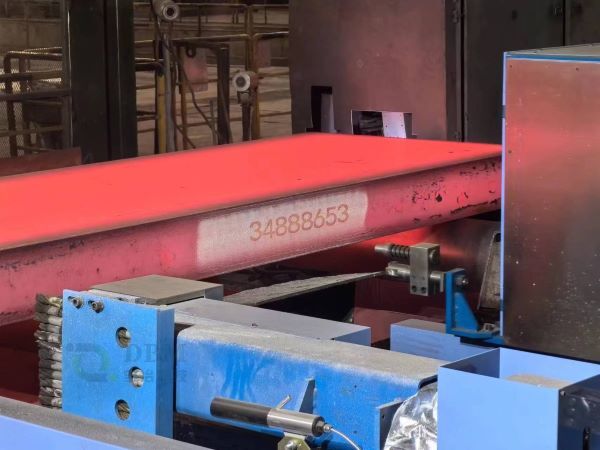
The label (laser, ink, aluminum wire) marking robot workstation is a variety of label marking solutions suitable for different operating scenarios, such as slabs, billets, hot-rolled coils, cold-rolled coils and other identity information, so that the processed products can be identified during transferring between processes and quality problems can be effectively traced. It also can be added with character recognition tracking system. From the perspective of economy and consumables, we give priority to recommending laser (white primer) label marking robot.
Content | Working principle and characteristics | Consumable media, spare parts, printing speed analysis |
Paint and aluminum wire marking machine | High-pressure pump, paint spraying, servo motion writing, can only write A-Z, 0-9 The molten aluminum wire is sprayed onto the surface of the billet | Consumables: paint/Kg/120-200, more than 2,000 yuan per barrel, annual paint cost is estimated to be about 800,000 (the annual consumables of metal aluminum wire are about 500,000) Shortcoming a. The nozzles are easy to clog. Frequent cleaning of the nozzles and pipelines in the later period requires more than two workers. b. The paint tube is easy to dry out. c. The paint filter is prone to sedimentation and damage d. The diaphragm pump is clogged. e. The identification of the billet count is inaccurate. f. Hygiene issues around the printer. g. The surface of the cast slab is uneven, the writing is broken, and it is easy to fall off. Printing effect: white writing on hot billet, Cold billet cannot be printed with writing Consumable parts: nozzle, nozzle, paint pipeline, paint filter, cooling water filter, pneumatic filter, diaphragm pump, nozzle solenoid valve, wire feed nozzle, electrode, welding machine, etc. |
Laser marking machine | The laser billet marking machine adopts laser melting, servo movement, laser beam printing, A-Z, 0-9, factory logo pattern, Chinese characters, etc. | No consumables, the printing speed is 13 characters per billet, the time is less than 4 seconds, the billet residence time is short Printing effect: gray and white writing on hot billets, black writing on cold billets Consumable parts: lens |
The system is equipped with an HMI human-machine interface server, which is mainly responsible for communication with the upper computer and automatic engraving;
Responsible for the selection of engraving fonts and fonts and the adjustment of on-site process parameters. The engraving equipment can correctly receive the engraving content transmitted by MES, and the end information will be fed back to the computer in time and the relevant operators will be notified by alarm;
1) Design high-temperature resistant cooling for high operating rate and harsh environment on site;
2) The font, word spacing, and font size are variable;
3) Multiple detection and protection measures fully avoid equipment damage caused by equipment failure, human operation, etc.
4), reduce maintenance costs and improve production efficiency;
5) Simple and intuitive software operation interface, online input or switching of spray number (engraved number) fonts,
6) Quick and intuitive understanding of equipment working status;
(1) Base
(2) Traversing the trolley and the box (horizontal and longitudinal strokes depend on the position of the billet)
(3) Laser engraving mechanism
(4) PLC electric control part
(5) Cooling equipment
(6) Slab position detection part
(7) Auxiliary detection and control software, etc.
(1) Cantilever beam (terminal base), a mechanical arm
(2) Traversing the trolley and box body (the longitudinal stroke of the car body depends on the error of the stop position of the billet)
(3) Laser engraving mechanism
(4) PLC electric control part
(5) Cooling equipment
(6) Slab position detection part
(7) Auxiliary detection and control software, etc.
(8) Scale removal mechanism
(1) The slab reaches the stop position and stops
(2) After the engraving machine receives the billet in place and the engraving data, it automatically puts in the engraving
(3) Signal to interlock between the conveying roller table and the engraving machine
(4) Descaling method: Mechanical or high-pressure water can be used to remove phosphorus
(5) Metal wire spray number, paint spray number: servo action realization, consumable wire, high-temperature paint
(6) Laser engraving does not require writing action, lens assembly
(1) Automatic mode – automatically provides data through PLC or a higher-level control system;
(2) Semi-automatic mode – input by the operator through the computer, automatically or manually start the engraving
(3) The machine engraves the billet;
(4) Manual mode — used for on-site emergency or online debugging;
(5) Data transmission Ethernet and optical fibre
A high-temperature heat-resistant insulation board is installed in front of the billet car to block the radiant heat of the billet. An axial flow fan is installed inside for air cooling. If necessary, a coolant refrigerator can be added to force cooling and air supply. This can ensure that the whole set of equipment operates reliably in a good temperature environment; built-in temperature monitoring, when the temperature reaches the alarm point, start the backup cooling system (reduce energy consumption)
In order to prevent the influence of Chinese and vibration during the working process of the body, the positioning and working process are more accurate and reliable. There is a professional separate cooling system and gas convection equipment for the equipment;
The use of guide rails, sliders, and servo codes enables the equipment to be positioned accurately during operation and walks smoothly, preventing positioning deviation caused by vibrations, and eliminating the blurring of the boundaries of the engraved fonts caused by vibrations during the engraving process; Improve running speed.
A: Yes. The system is specifically designed for the metallurgical “Red Zone.” Whether using laser or pneumatic technology, the markings are etched directly into the billet surface. These marks maintain high contrast and legibility at temperatures exceeding 800°C – 900°C, ensuring that the heat number and batch ID remain traceable even after exiting the reheating furnace or passing through high-pressure descalers.
A: Our marking machine is equipped with 3D position compensation technology and intelligent sensors. Before the marking head engages, the system automatically detects the distance and inclination of the billet end-face. This allows the robot or mechanical arm to adjust its trajectory in real-time, ensuring consistent depth and clarity even on uneven or tilted casting surfaces.
A: The marking cycle is optimized for high-throughput environments, typically taking only a few seconds per billet. To prevent production bottlenecks, the system supports seamless integration with your MES and PLC networks via protocols like OPC UA or Profinet. It receives marking data automatically from the level-2 system, allowing for “on-the-fly” identification without stopping the conveyor.
A: Reliability in harsh environments is a core design principle of DBM. The marking head is protected by an IP65/IP67 stainless steel enclosure equipped with a liquid-cooling jacket. Additionally, a positive-pressure air-seal purging system keeps the lens and marking mechanism free of metallic dust and steam, significantly extending the life of consumables and reducing maintenance frequency.
A: Transitioning to an unmanned marking area significantly reduces safety risks by removing workers from high-heat zones prone to spark splashes. Most mills achieve ROI within 12 to 18 months by eliminating the costs of physical tags, manual labor, and the high expense of “identity-lost” billets that would otherwise require manual re-testing or downgrading.
Need help? Our team is just a message away